

Five miles from everywhere
Nazeing sits on the Essex side of the River Lea, where the land rises gently from the water meadows to a bowl-shaped plateau about 270 feet above the sea. It is a parish of open farmland, old lanes and scattered hamlets — Upper, Middle and Lower Nazeing — with Lower Nazeing the largest. The Prime Meridian runs just to the west.
It is said to be one of the largest villages in the UK, yet most of it is still rural — which is exactly why it suits horses so well.
A short history
- 2,000+ years ago
Iron Age pottery found in the parish shows people have lived here for more than two thousand years. Roman burials were later found in Nazeing Mead, by the river.
- 600s
Saxon settlers arrive. The name probably means “people of the headland” — from the Old English næss, a spur of land, the same root as “nose”.
- 1062
Earl Harold — soon to be King Harold — grants Nazeing to found Waltham Holy Cross, the abbey church at Waltham.
- 1086
The Domesday Book records Nasinga: seven villagers, twelve smallholders, one free man, seven cattle and thirty pigs.
- 1200s
Nazeingwood Common, once part of Waltham Forest, is cleared for pasture.
- 1779
The church’s five bells are recast by Pack & Chapman of Whitechapel.
- c.1780–1820
William Palmer, a London merchant, builds Nazeing Park, the Georgian mansion still seen from Nazeing Common Road.
- 1795
The Congregational church on Middle Street is founded.
- 1883
Nazeing Common Cricket Club is established.
- 1928
Glassmaking arrives when the Kempton family move their works from Southwark — Nazeing Glass Works traces its craft back to 1612.
- 1930s
The Lea Valley holds the largest concentration of greenhouses in the world, growing much of the country’s salad.
- 1940–41
Nazeing Common becomes a dummy airfield, lit at night to draw enemy bombers away from RAF North Weald. Its wartime bunkers are now protected.
- 1964
St Giles’ Church is built at the crossroads, half of its cost raised by the village.
Grade I listed
All Saints’ Church
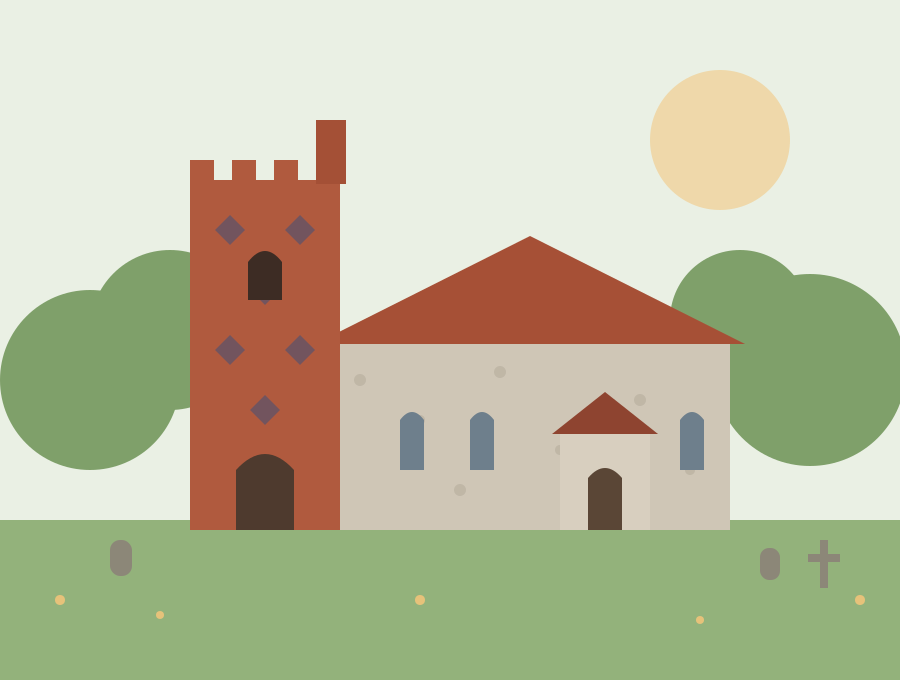
Standing among trees on Betts Lane, north of the old village, All Saints is the heart of Nazeing’s history. Its story is said to begin in the earliest Christian times, with a religious house led by an Anglo-Saxon abbess named Fymme.
- The oldest building in the parish
- A church is believed to have stood on the site since the end of the sixth century. Today’s building has a Norman nave, a 15th-century north aisle and porch, and a striking early 16th-century tower.
- That red-brick tower
- Built of red brick with a pattern of darker blue bricks, it is crowned with battlements and a raised stair turret — a landmark above the trees.
- Flint and clunch
- The walls are flint rubble dressed with clunch, a soft local chalk stone, under red tiled roofs.
- Birds in the glass
- Early 21st-century stained glass by Peter Cormack includes a heron, a thrush, goldfinches, a wren and an owl — worth seeking out.
- Still a living church
- All Saints and St Giles form one parish. All Saints holds a service on the first Sunday of each month, and has a step-free rear door.

Out and about
The common and the valley
Nazeingwood Common covers much of the high ground in the east of the parish. It was ploughed during the Second World War, when its rolling slopes also hid a decoy airfield — the bunkers still stand near Nazeing Brook.
- Lee Valley Regional Park
- Clayton Hill and the lakes along the river are favourites with walkers and dog owners. Old gravel pits are now home to sailing, water sports and fishing at Nazeing Meads.
- Horses in the neighbourhood
- Redwings’ Ada Cole Rescue Centre at Broadley Common cares for around seventy rescued horses, ponies and donkeys, and welcomes visitors — check its opening times before you go.
- Old lanes and listed cottages
- The lane to the common is lined with listed cottages and the old post office, and Lodge Farm on the edge of the common dates from 1777.
Nazeing and the New World
Several 17th-century families from Nazeing sailed for New England, and their stories travelled far.
Lived here as a boy. In Massachusetts he became the “Apostle to the Indians”, translating the whole Bible into the Algonquian language.
From Nazeing — an ancestor of Walter Camp, remembered in America as the “Father of American Football”.
Born in Nazeing — an ancestor of the veterinarian Daniel Elmer Salmon, after whom salmonella is named.
Come and see it for yourself
Pentonville Lodge is on Long Green Road, between the common and the Lee Valley — ten minutes from Broxbourne station.
Sources: British History Online (Victoria County History of Essex), Historic England, the Parish of Nazeing All Saints and St Giles, and Wikipedia. Illustrations drawn for this site.