
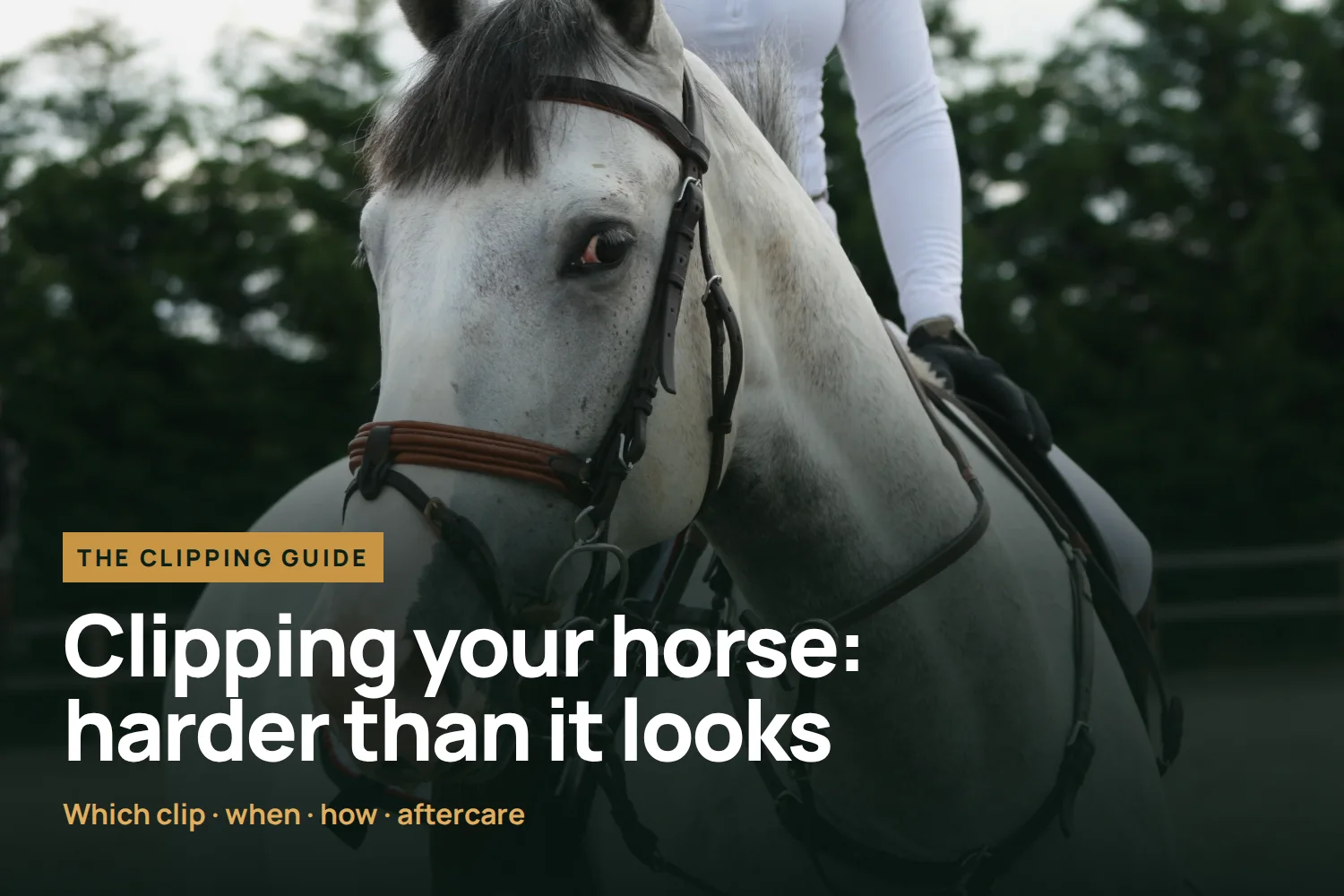
Clipping looks simple — until you’re halfway round a fidgety horse with hot blades and wonky lines. Done well, it keeps a hard-working horse comfortable all winter. Here’s what’s involved, and when it’s worth calling in someone experienced.
Why clip at all?
A horse in work grows a thick winter coat, sweats heavily, and takes hours to dry — which risks chills and lost condition. Clipping removes some of that coat so your horse can work comfortably and dry quickly. The trade-off: a clipped horse needs rugs to replace the coat you’ve taken away.
Which clip?
- Bib or Irish clip: the neck and chest — ideal for horses in light work who mostly live out.
- Trace clip: the underside of the neck, belly and upper legs — a popular middle ground.
- Chaser clip: from the poll down along the neck and belly — more coat off, still keeps the back and loins warm.
- Blanket clip: everything except a “blanket” over the back and the legs — for horses in regular, harder work.
- Hunter clip: all off except the legs and a saddle patch — for horses in hard work.
- Full clip: the whole coat off — for horses in heavy work, and the most rugging.
The rule of thumb: the harder your horse works and the more it’s stabled, the more you can take off.
When to clip
Usually from autumn, once the winter coat has properly come through, then again every few weeks as it grows back. Many owners stop by late winter so the new summer coat comes through cleanly.
Why it’s harder than it looks
- Nervous horses. The noise and vibration can upset even sensible horses. Never try to force it — if sedation is needed, it must be given by your vet.
- Hot blades. Blades heat up fast and can burn. Oil them regularly, check the temperature with the back of your hand, and stop to let them cool.
- Straight, even lines. Mark them first with chalk or tape and step back often to check both sides match.
- Tricky areas: elbows, the stifle, the head and around the ears take practice and a patient horse.
- Safety: use well-maintained clippers, a circuit breaker with mains clippers, and a clean, dry horse on a non-slip surface — with a helper to hold.
Good-practice tips
- Start with a clean, completely dry coat — dirt blunts blades and causes lines.
- Clip against the direction of the hair, with long, steady strokes.
- Leave a small triangle at the top of the tail for a neat finish.
- Leave the whiskers: horses use them to feel their surroundings, and trimming them is banned in FEI competition.
- Rug up straight away — your horse has just lost its coat.
Let us do it
We clip horses and ponies at Pentonville Lodge for £70, with patience for nervous ones and neat, even lines. Send Nikki a message to book — and read our winter horse care guide for rugging a newly clipped horse.
Nikki Ward · Pentonville Lodge
For the latest from the yard, follow us on Instagram · Facebook · YouTube · X.