
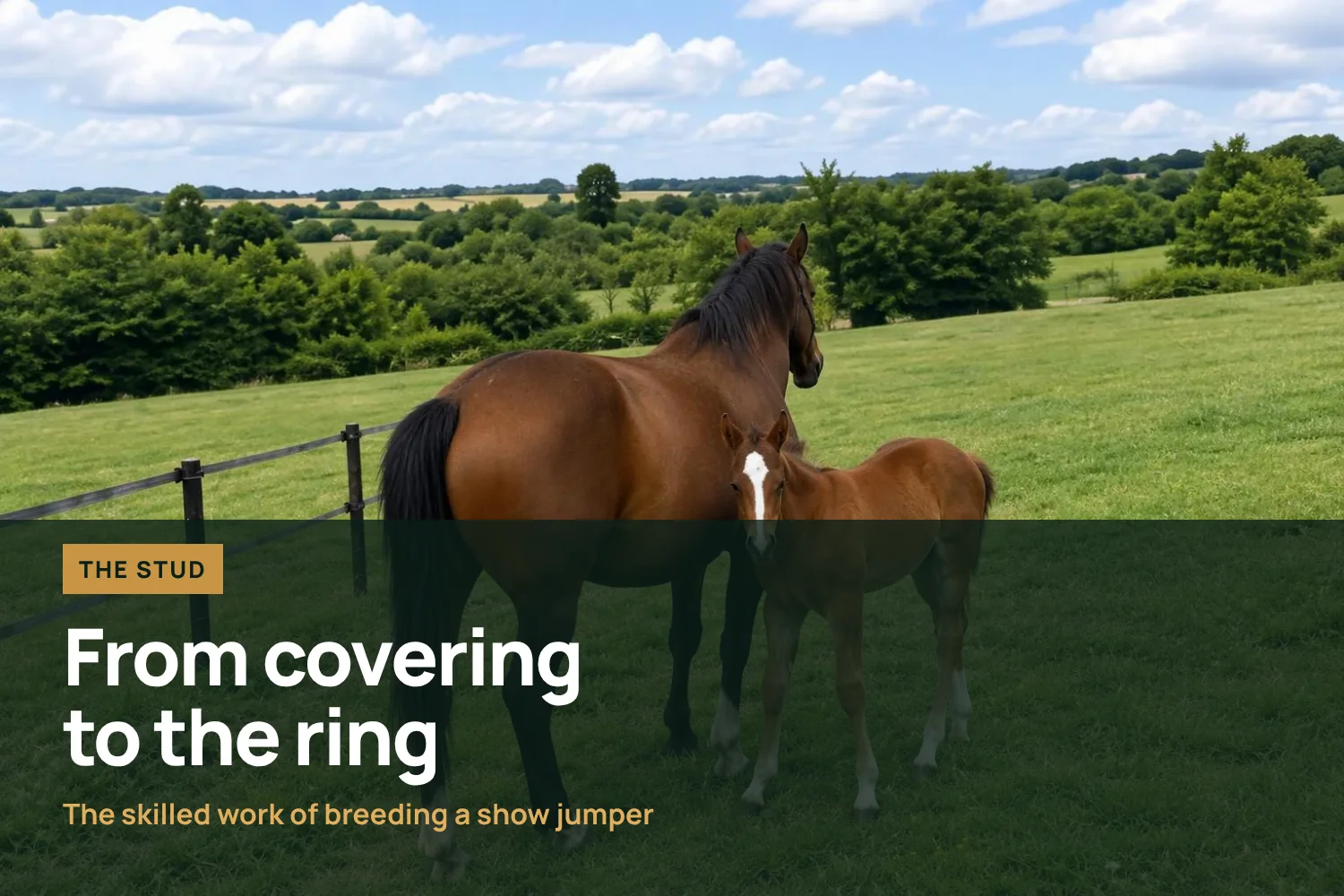
A foal in a field looks like the simplest thing in the world. It isn’t. Behind every one is more than a year of planning, eleven months of careful pregnancy, a birth where minutes matter, and then years of patient work before anyone knows what the horse will become. This is how it really happens, from start to finish.
It starts long before the covering
Good breeding begins with an honest look at the mare. Is she sound, healthy and the right age? Has she the temperament, movement and jump worth passing on? A mare gives her foal half its genes, and she also brings it up for its first six months, so her nature matters as much as her pedigree.
Then comes the stallion, chosen to complement her, not just because he is famous. If the mare lacks a little scope, you look for a stallion who adds it. If she is hot, you look for calm. His grading, his own competition record and the records of the foals he has already produced all count.
Before she can be covered, the mare needs a full vet check and swabs and blood tests for the infections studs screen for, such as contagious equine metritis and equine viral arteritis, following the industry code of practice. Her feet, teeth, worming and vaccinations are all brought up to date. None of it is glamorous, and all of it matters.
The covering: timing is everything
Mares come into season roughly every three weeks through the spring and summer, and they only ovulate once each time. Hitting that window is a skill. The vet scans the mare’s ovaries, sometimes several times in a few days, watching a follicle grow until it is the right size to release an egg.
There are three ways to get the mare in foal:
- Natural covering, at the stallion’s stud, with experienced handlers and the risk that comes with putting two powerful horses together.
- Artificial insemination, with fresh, chilled or frozen semen, timed to the hour by scanning. It opens up the best stallions in Europe without the travel.
- Embryo transfer, where the embryo is flushed from the mare about a week after ovulation and placed in a recipient mare, who carries the foal. The donor mare can keep competing, or have more than one foal in a season. It is how Pentonville Lodge will breed from its next crop of mares, who are related to Kannan and Tangelo.

Eleven months of waiting, and watching
The first scan comes at around 14 to 16 days. It answers two questions: is she in foal, and is there more than one? Twins are dangerous for a mare and rarely survive, so if the vet finds two, one is pinched out there and then. At around four weeks a second scan should show a heartbeat, and later scans confirm all is still well.
Pregnancy lasts about eleven months, and a normal one can run several weeks either side. Through it the mare is vaccinated against equine herpes virus at five, seven and nine months, because the virus can cause her to lose the foal. Her diet is adjusted as the foal grows, especially in the last three months, when most of its growth happens. Too little and the foal suffers; too much and the mare gets fat, which brings its own problems at foaling.
About a month before she is due, she has her flu and tetanus booster, so her first milk carries those antibodies to the foal. Then the watching begins in earnest.
The birth: where minutes matter
Mares like to foal in the quiet of the night, and they can hold off if they feel watched. In the last weeks the udder fills and the muscles around the tail soften, and a day or two before, many mares “wax up”: beads of milk appear on the teats. But plenty of mares break every rule, so breeders use foaling cameras and alarms, and sleep in short shifts for weeks.
When it starts, it is fast. Once the waters break, the foal should arrive within about twenty to thirty minutes: two front feet first, one slightly ahead of the other, with the nose resting on them, like a diver. If anything else appears, or nothing progresses, the vet is needed immediately. The most feared sight is a red, velvety bag appearing instead of the clear membrane. This “red bag” means the placenta has come away early and the foal is losing its oxygen, and someone has to open it and help the foal out within moments.

The first hours
A healthy foal should be standing within about an hour and suckling within about two. That first milk, the colostrum, is everything: a foal is born with no immunity of its own, and it can only absorb those antibodies through its gut in the first hours of life. Many breeders have the vet test the foal’s blood at around 12 to 24 hours to make sure enough has gone in.
The mare needs watching too. The placenta should come away within about three hours, and it is laid out and checked to make sure none has been left behind, because a retained piece can make the mare seriously ill. The foal’s navel is dipped, its first droppings are watched for, and both are checked again and again through the first night.
The risks no one sees
Most foalings are textbook. The ones that aren’t can turn in minutes. A foal can be badly positioned and stuck. A mare can bleed, or reject her foal. A foal can be born weak, slow to suckle, or confused and unable to find the udder. Infections can settle in the navel or the joints. This is why foaling is never left to chance, why the vet’s number is on speed dial, and why experienced breeders know what normal looks like so well that they spot the first sign of trouble.
Bringing them up
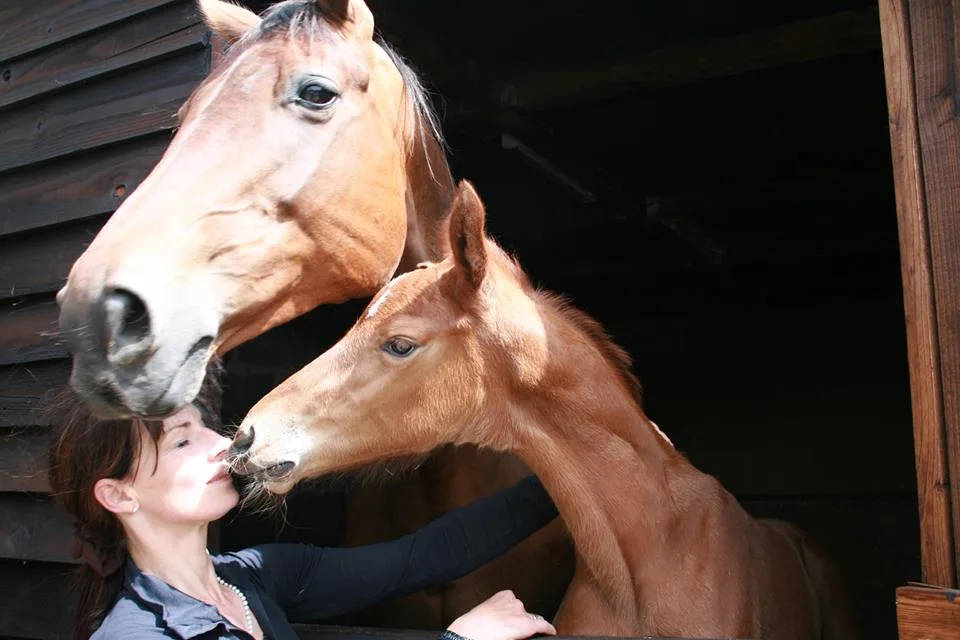
From the first days, a foal is handled gently every day: touched all over, led beside its mother, taught to wear a foal slip and to pick up its feet. Those early lessons decide whether it grows into a horse that is easy to vet, shoe, load and ride. The farrier sees foals early too, because small corrections to growing legs can only be made while they are young.
Weaning comes at around six months and is done carefully, with company the foal knows, because it is one of the most stressful moments of a young horse’s life. After that come vaccinations, a worming plan based on regular egg counts, and seasons of growing up in the field with other youngsters, learning to be a horse.
Feeding a growing athlete
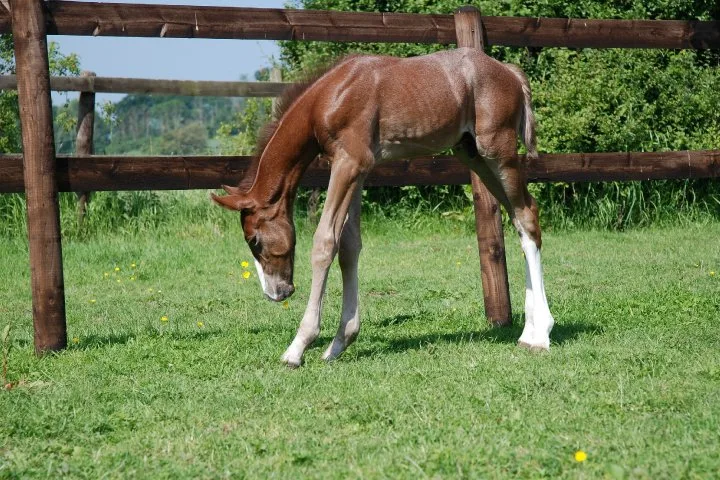
A young warmblood grows fast, and it is tempting to push it. It is also a mistake. Growing too fast, or on an unbalanced diet, can damage developing joints and cause problems that only show up years later, when the horse starts work. The aim is steady, even growth: good forage, the right minerals and vitamins, and grazing and space to move, adjusted as the horse changes through each stage.
Training: years before the first show
A yearling learns to travel, stand for the farrier and lead politely. At two or three, a youngster may be loose jumped once or twice, so its breeder can see its natural technique without the weight of a rider. Backing usually comes at three, carefully and in short spells, followed by time off to grow. Real jumping work builds slowly from there, with the first young horse classes at four or five. Rush any of these steps and you can spoil a talented horse for good.

Great parents don’t guarantee a great horse
Here is the honest truth every breeder lives with. Two brilliant parents give you a better chance, not a certainty. Genetics shuffle the deck every time: a foal can inherit its sire’s scope and its dam’s worst habit, or neither parent’s best qualities at all. Then come things no pedigree controls: a knock in the field, a growth problem, a horse that is talented but simply doesn’t love the job.
Only a small number of foals, even from the best lines, go on to jump at the top. Many more become lovely amateur horses, happy hunters or brilliant schoolmasters, and that is a success too. What a breeder can do is stack the odds: choose the parents with care, raise the foal properly, and produce it patiently, with the skill to see what each horse needs. That is where years of experience make the difference.
At Pentonville Lodge
Pentonville Lodge is a private stud, home mainly to Nikki’s own mares, and most of the horses on the yard were bred here. Its stallion is Sky High, a silver badge elite show jumper by Goborius Ranaldo who was placed in Grands Prix in the UK and Dubai, and next season’s mares are related to Kannan and Tangelo. You can read more on the stud page, or get in touch with Nikki.
Nikki Ward · Pentonville Lodge
For the latest from the yard, follow us on Instagram · Facebook · YouTube · X.